Investment Market Report – Hervey Bay, QLD
Government infrastructure. Interstate migration. Rising employment. Hervey Bay is no longer just a retirement town — it is one of Queensland’s most compelling regional growth stories.

OVERVIEW
A City on the Move – with a story to back it
Hervey Bay is quickly emerging as one of Queensland’s most compelling regional growth markets, with strong fundamentals supported by ongoing government investment, infrastructure development, and increasing migration into the area.
Once known primarily as a lifestyle and retirement destination, the city is now transitioning into a more diversified regional economy. This shift is being underpinned by a growing pipeline of infrastructure projects, job creation, and improved amenity — all of which are contributing to sustained demand for housing.
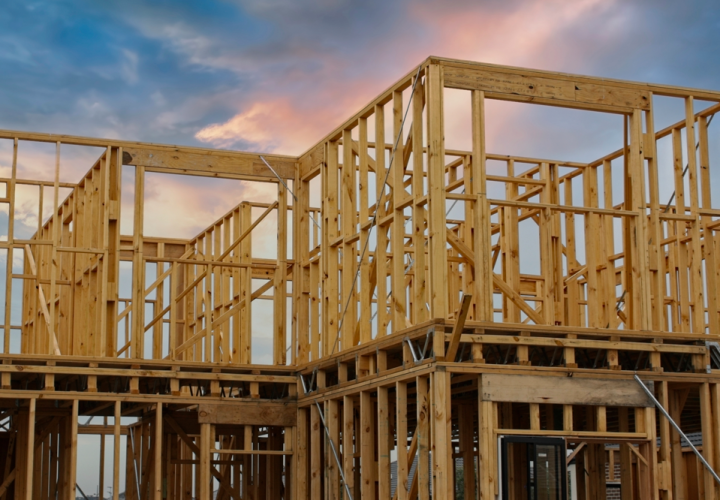
To understand what is really happening on the ground, our team recently travelled to Hervey Bay to inspect a wide range of locations firsthand. During this trip, we reviewed multiple properties across different stages — including completed builds, homes currently under construction, and projects still in the planning phase — all of which have already shown strong signs of growth.
We were particularly impressed with the level of movement across the region, the amount of infrastructure being delivered, and the overall quality and feel of the area on the ground.
There is a clear sense of momentum, with both development activity and buyer demand evident throughout multiple suburbs. This firsthand insight reinforces our confidence in the region’s trajectory and the strength of the underlying fundamentals driving growth.
A Region That Is Growing Fast
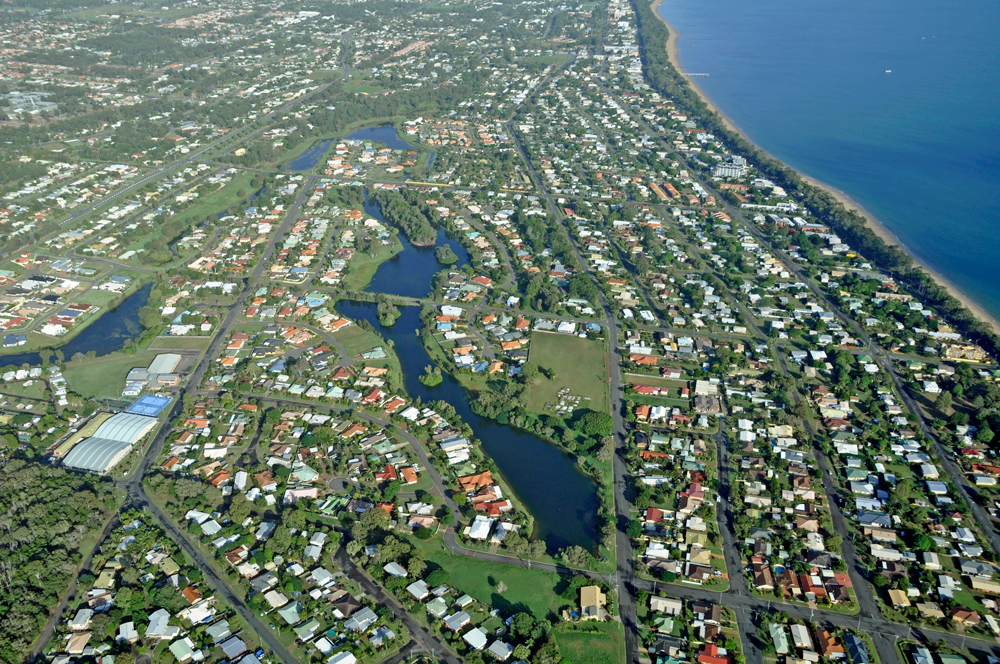
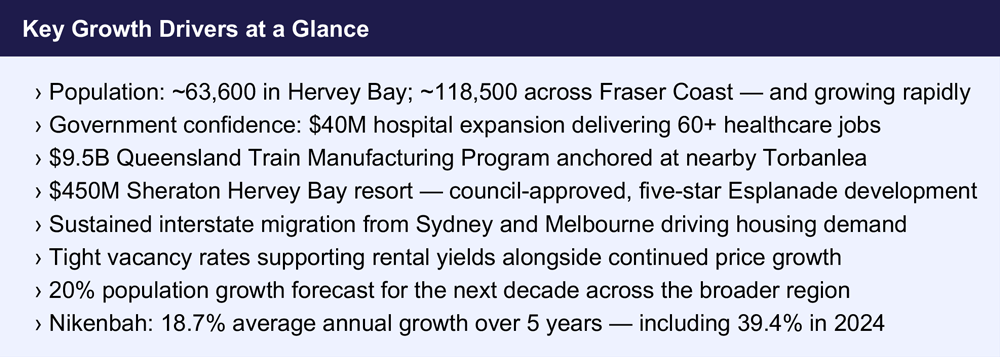
To put the scale of Hervey Bay’s growth in context, it helps to look at the numbers. Hervey Bay’s estimated resident population reached approximately 63,579 as of June 2023, according to ABS data — up from 57,722 at the 2021 census and 52,073 in 2016. That’s nearly 11,500 additional residents in just seven years.
Zoom out to the broader Fraser Coast region — which includes Hervey Bay, Maryborough, K’gari (Fraser Island), and surrounding areas — and the story becomes even more compelling. The regional population sat at 111,032 at the 2021 census and had already climbed to an estimated 118,505 by 2024, representing a significant post-COVID surge. Pre-pandemic, that figure was around 106,796, meaning the region added approximately 12,000 people in just four years.
With projections suggesting the Fraser Coast could reach 150,000 to 160,000 residents within the next 20 years, the region is no longer a quiet coastal outlier — it is one of Queensland’s fastest-growing corridors outside of Southeast Queensland.
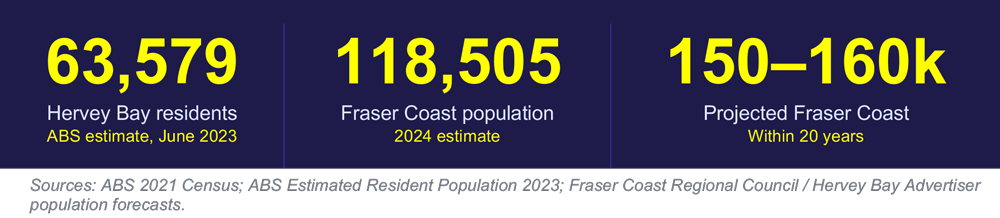
Sources: ABS 2021 Census; ABS Estimated Resident Population 2023; Fraser Coast Regional Council / Hervey Bay Advertiser population forecasts.
MARKET PERFORMANCE
What the Numbers Are Telling Us
A clear example of the growth story can be seen in suburbs such as Nikenbah, where recent data from CoreLogic (Cotality) RP Data highlights the strength of the market. Over the past five years, the suburb has delivered an average annual growth rate of approximately 18.7%, supported by several standout years — including 38.4% growth in 2022 and 39.4% growth in 2024.
While there have been minor corrections in between, what stands out is not any single year of performance, but the consistency over time. A market that averages nearly 19% annual growth over five years — including two years above 38% — is not behaving like a volatile fringe suburb. It is demonstrating the characteristics of a resilient, structurally-supported growth market.

Source: CoreLogic (Cotality) RP Data — Nikenbah Suburb Statistics Report.
ON THE GROUND
What Locals Are Saying
On our first trip to Hervey Bay, one of the most interesting insights came not from data, but from simply speaking with locals. A common theme emerged almost immediately: how many people had relocated post-COVID in search of a better lifestyle — packing up from major cities like Sydney and Melbourne, selling at significantly higher price points, and moving into Hervey Bay where they could purchase a home for often half the cost.
For many, it was the ideal scenario. A coastal lifestyle, a lower cost of living, and the ability to effectively “downsize” financially while genuinely upgrading their quality of life. Warmer weather, calmer streets, world-class whale watching, and easy access to Fraser Island all packaged at a fraction of what life costs in the southern capitals.
What’s particularly interesting is how that conversation has evolved. If you speak to locals now, the demographic and sentiment feel noticeably different.
The region is no longer seen purely as a retirement or lifestyle destination. It is increasingly being viewed as a place of opportunity, growth, and long-term potential. The profile of people arriving has changed — alongside the retirees and downsizers are now working families, young professionals, and investors who have done their homework and like what they see.
This shift in perception is significant. When a market moves from being seen as a retirement haven to a genuine growth hub, it typically signals a broadening of the economic base and a deepening of demand — exactly the conditions that sustain long-term price growth rather than short-lived spikes.
INFRASTRUCTURE — HEALTHCARE
The Hospital Expansion: A Government Confidence Signal
A big part of that regional shift has been driven by ongoing investment into critical infrastructure, particularly the Hervey Bay Hospital expansion. The hospital has undergone significant upgrades as part of Queensland’s multi-billion-dollar health infrastructure program, and the scale of what has been delivered is telling.
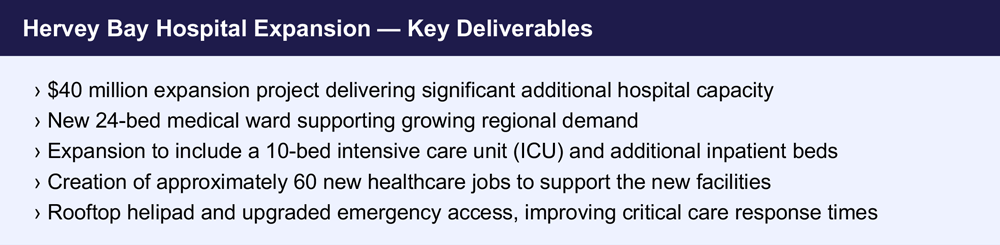
This level of investment is not just about healthcare. It is a clear signal of government confidence in the region’s long-term population growth, which is forecast to increase by around 20% over the next decade. Governments do not spend tens of millions expanding hospitals in markets they expect to stagnate.
From our perspective, infrastructure like this is one of the most reliable indicators of a market transitioning into its next phase of growth. It brings stable employment, attracts professionals and families, and underpins long-term housing demand in a way that is durable rather than cyclical. A new hospital wing draws nurses, doctors, administrators, and allied health workers — and those people need homes.
Governments do not spend tens of millions expanding hospitals in markets they expect to stagnate. Infrastructure spending is one of the clearest signals of long-term confidence.
INFRASTRUCTURE — MANUFACTURING
$9.5 Billion in Train Manufacturing — Right on the Doorstep
A key driver behind the region’s performance is the continued government and private sector investment flowing into the Fraser Coast. One of the most significant projects is the Torbanlea train manufacturing facility, part of Queensland’s $9.5 billion Queensland Train Manufacturing Program (QTMP). This facility, located just outside Hervey Bay, is expected to support approximately 300 direct local jobs — around 200 trades and 100 professional roles — while contributing to up to 1,300 jobs across the broader program lifecycle.
The project will see the construction of 65 new passenger trains, positioning the Fraser Coast as a key hub for advanced manufacturing in regional Queensland. Importantly, this represents a shift toward higher-skilled, higher-income employment — the kind of jobs that bring young professionals to a region, create stable household incomes, and translate directly into housing demand.
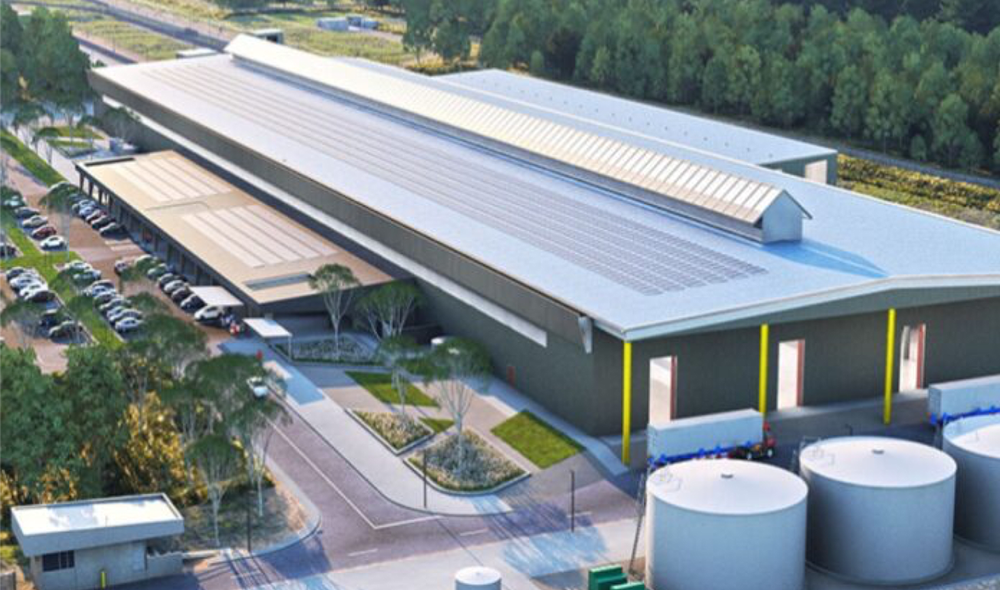
Image: Concept design of Torbanlea manufacturing facility. Credit: tmr.qld.gov.au

Beyond just job creation, infrastructure projects of this scale have a multiplier effect across the local economy — driving demand for housing, supporting local businesses, and increasing population inflows as workers relocate to the region. This diversification away from traditional reliance on tourism and retirement living is a key factor underpinning more stable and sustainable property market growth, as it broadens the economic base and strengthens long-term demand fundamentals.
INFRASTRUCTURE — TOURISM & HOSPITALITY
The $450M Sheraton: Redefining Hervey Bay’s Profile
Tourism continues to play a major role in Hervey Bay’s growth story, and significant investment is now moving from concept into reality. The most striking example is the proposed Sheraton Hervey Bay resort — a $450 million, five-star development along the Esplanade in Torquay, which has been approved by council and is set to become the largest hotel of its kind between Brisbane and Cairns.
This is not a speculative concept or a community wish-list item. It has council approval and is backed by serious capital. The scale of the project — over 200 hotel rooms, residential apartments, retail and entertainment spaces — will fundamentally change the character of the Esplanade and position Hervey Bay as a premium coastal destination on the national and international stage.
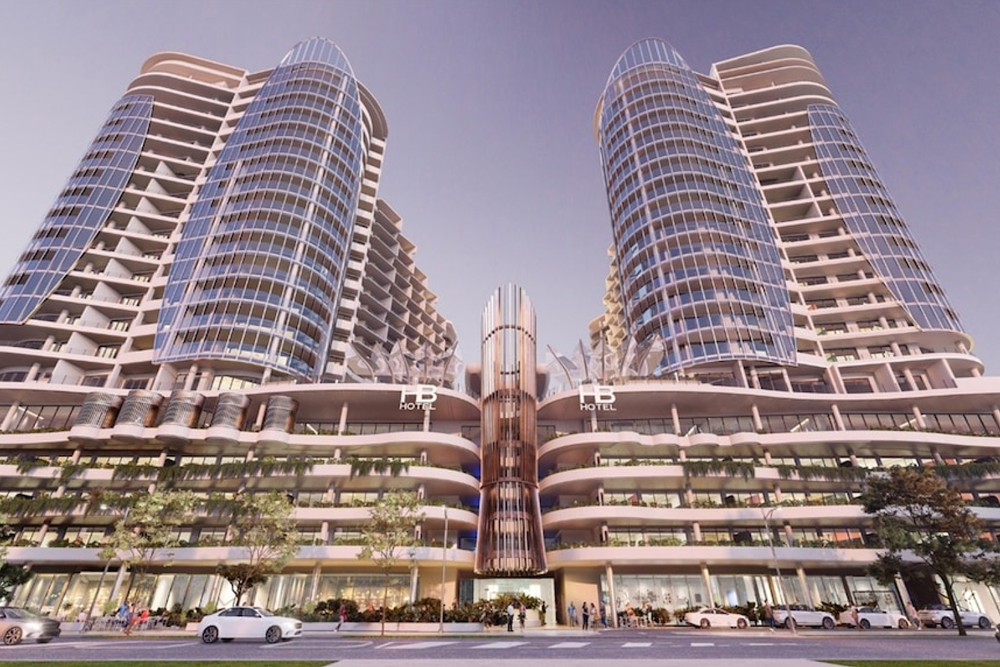
Image: Artist impression of the proposed Sheraton Hervey Bay resort.

Developments of this scale are critical signals for regional markets. They elevate tourism appeal, attract higher-spending visitors, and create long-term employment opportunities. Perhaps more importantly, they change the perception of a place — from a quiet regional town to a destination worth visiting, living in, and investing in. That shift in perception has a direct and lasting effect on property values.
With this level of investment occurring directly along the Esplanade, the flow-on effects are expected to be significant — increasing demand, boosting investor confidence, and supporting continued growth across the local property market.
MARKET DYNAMICS
Supply, Demand & the Lifestyle Premium
From a lifestyle perspective, Hervey Bay remains highly attractive and relatively affordable compared to larger Queensland markets. Its coastal setting, relaxed pace of life, and proximity to some of Australia’s most iconic natural attractions — K’gari, the Great Barrier Reef, the humpback whale migration corridor — continue to draw interstate migration, particularly from Sydney and Melbourne. This population growth is a key factor supporting both rental demand and long-term price growth.
Vacancy rates remain tight, indicating strong rental demand, while new housing supply is being carefully absorbed by the market. This balance between supply and demand is important — it helps maintain upward pressure on both rents and property values without creating excessive volatility. Unlike some markets that spike on speculation, Hervey Bay’s growth is being driven by real people with genuine housing needs.

Hervey Bay is now evolving into a well-rounded coastal market, attracting not only downsizers but also families, investors, and working professionals. With continued infrastructure investment, employment growth, and strong population inflows, the area is offering far more than just lifestyle — it is becoming a genuine growth market with depth and diversity.
FORWARD LOOKING
Where Hervey Bay Is Headed
Looking forward, Hervey Bay appears well positioned to continue benefiting from a combination of infrastructure investment, population growth, and lifestyle appeal. As more projects move from planning into delivery, the region is likely to see further improvements in employment, connectivity, and overall liveability. The Sheraton development, the train manufacturing facility, and the hospital expansion are not the end of the story — they are the opening chapters of a significant decade of change.
In many ways, Hervey Bay is following a familiar pattern seen in other successful coastal growth markets — moving from an under-recognised lifestyle destination into a fully supported regional hub. That transition, once it begins in earnest, tends to attract further investment, further population growth, and further confidence — creating a self-reinforcing cycle of growth that rewards early movers.
With government spending continuing and confidence clearly building, the area is showing strong signs that this transition is well underway. For investors who understand the fundamentals and are willing to look beyond the capital cities, Hervey Bay presents a compelling and well-supported case for long-term growth.
Hervey Bay is following a familiar pattern seen in other successful coastal growth markets — moving from an under-recognised lifestyle destination into a fully supported regional hub.
For further insights on property investment, avoiding common pitfalls and staying informed about market conditions. reach out to John Tsoulos or Frank Pennisi at IFP Advisory on (08) 8423 6176. Your investment success depends on making informed, strategic decisions.
IFP Advisory is an Accredited ASPIRE Property Advisor Network advisor and all professionals are Qualified Property Investment Advisors (QPIA). Property investing is about purchasing a property that aligns with your goals and investment strategy. You should never be sold an investment. Know your numbers! If you invest wisely and strategically, the Australian residential property market can be a rewarding venture.
This report is intended for informational purposes only and does not constitute financial or investment advice. Past performance is not indicative of future results. Readers should seek independent professional advice before making any investment decision.