
Time vs Timing: The key to smarter property investing
For many first-time investors, one of the biggest misconceptions about property investing isn’t what they invest in — it’s when and how long. At first glance, the idea of “buying low and selling high” sounds simple. But in real estate, timing the market — trying to buy at the absolute lowest point and sell at the peak — is a much riskier and less reliable strategy than simply focusing on time in the market. Understanding the difference can dramatically shape both your mindset and your long-term success as an investor.
Timing the market: tempting but treacherous
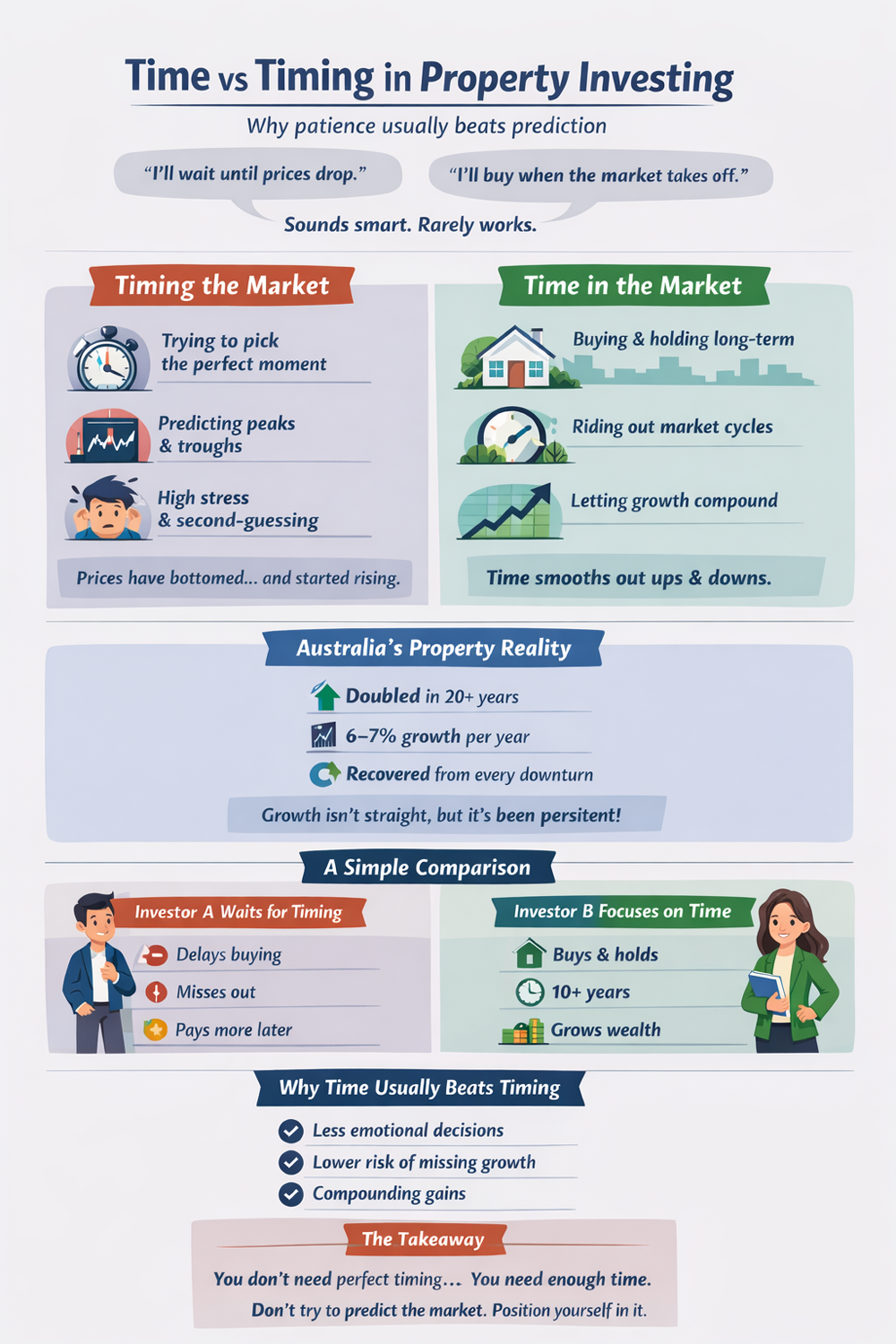
“Timing the market” refers to trying to predict the best moment to buy (or sell) property based on short-term price movements or economic signals. It’s an alluring idea: buy when prices have just dipped and sell just as they start rising. But in practice, this is extremely hard to do — even for professionals.
In the Australian context, experts warn that accurately timing property cycles is difficult because market peaks and troughs often only become clear in hindsight. Property markets don’t move smoothly — they go through phases of rapid growth, slowdowns, corrections and plateaus, often driven by interest rates, policy settings and economic factors that are hard to predict with precision.
For example, over the past 20 years Australian dwelling values have more than doubled, but this long-term upward trend included multiple ups and downs — from the global financial crisis slowdown to the COVID-19 boom and subsequent correction.
Timing these swings perfectly — buying at the exact bottom and selling at the very top — is a risky gamble. One recent national study even identified regions with extreme volatility — such as Port Hedland where values once plunged from ~$900,000 to $210,000 — showing that short-term movements can be unpredictable and painful for ill-timed investors.
Time in the market: the power of patience
In contrast, “time in the market” is about buying with a long-term horizon and holding an asset through different phases of the property cycle. This approach lets you benefit from two of the most important forces in property investing: capital growth and compounding.
Australian historical data supports this strategy:
- Over the past 30 years, Australian house values have grown at an average of around 6–7% per year, despite economic cycles and occasional downturns.
- Long-term capital growth can multiply value significantly. A home bought in 1991 for ~$122,870 would be worth over $795,000 in 2021 — more than six times its original price.
- Even when short-term fluctuations occur, the long-term trend has generally been upward — illustrating how “time” smooths out volatility that can derail short-term strategies.
This doesn’t mean prices always rise smoothly. Markets cycle. But when you own property for a long period — often a decade or more — temporary dips have historically mattered less than the overall growth trajectory.
Why time outperforms timing for first-time investors
Here’s how the distinction translates into practical outcomes:
- Reduces emotional decision-making
Trying to time the market often leads to stress, second-guessing and reactive choices. Holding a long-term view helps you focus on fundamentals like rental income, location quality and affordability rather than market noise. - Captures overall growth, not short swings
Short-term movements are inherently unpredictable. But over decades, structural drivers of demand — such as population growth, limited supply and stable economic fundamentals — have historically pushed Australian property values higher. - Benefits from compounding returns
Longer holding periods allow compounding to work in your favour, both through capital growth and rental income reinvestment. Even modest annual growth rates build significant wealth over time.
Real-world lesson for aspiring investors
Let’s bring this to life with two hypothetical first-time investor scenarios:
- Investor A tries to time the market.
They delay buying, waiting for a predicted “dip”. That dip never materialises in a clear way, or they miss it — and prices rise. By the time they buy, the same property costs far more, narrowing potential returns. - Investor B buys with a long horizon.
They choose a well-located property and hold it. Over a decade, despite cycles, they see compound growth and rental income accumulate. Their overall investment performance is stronger and less stress-laden.
Final thought: invest with horizon, not hindsight
For first-time property investors, recognising the difference between time and timing can be game-changing. Australian property data shows that over long periods, capital growth tends to reward patient investors — while short-term market predictions often disappoint. Focus on fundamentals: choose quality assets, understand your financial capacity, and plan to hold long enough to let time do the heavy lifting.
Bottom line:
Don’t wait for perfect timing — build wealth by time in the market.
For further insights on property investment, avoiding common pitfalls and staying informed about market conditions. reach out to John Tsoulos or Frank Pennisi at IFP Advisory on (08) 8423 6176. Your investment success depends on making informed, strategic decisions.
IFP Advisory is an Accredited ASPIRE Property Advisor Network advisor and all professionals are Qualified Property Investment Advisors (QPIA). Property investing is about purchasing a property that aligns with your goals and investment strategy. You should never be sold an investment. Know your numbers! If you invest wisely and strategically, the Australian residential property market can be a rewarding venture.